The EPA-funded project ISO-TAISE (“taise” referring to the Gaeilge word for moisture) is focused on better understanding the conditions that produce Ireland’s most extreme and rain-heavy storms. Some of Ireland’s worst flooding and rains result from a particular weather phenomenon known as an atmospheric river. By continuosly monitoring the stable isotopes of the oxygen and hydrogen in water vapor flowing over Ireland, ISO-TAISE aims to gain new insights into what exact conditions help to trigger and fuel these hazardous storms.
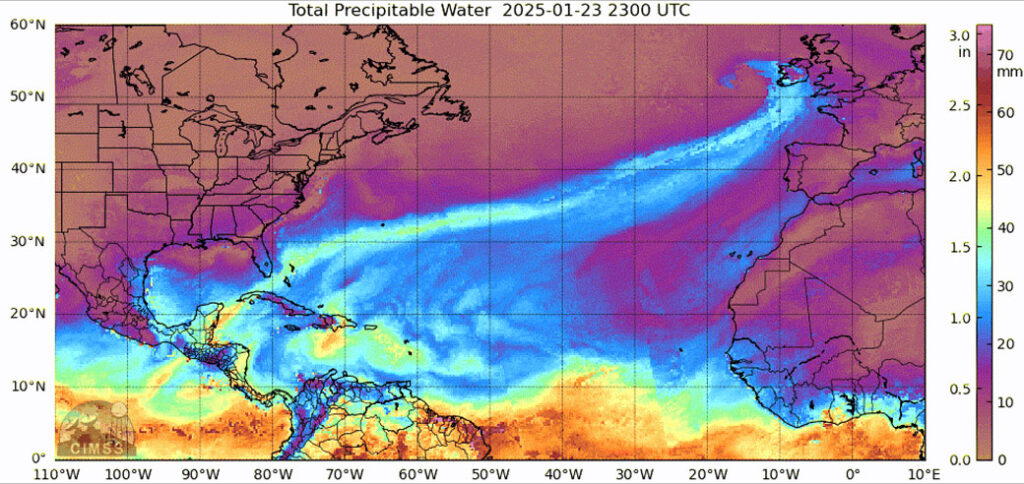
Atmospheric rivers, or ARs for short, are long, narrow, and flowing corridors of high moisture content that can stretch for hundreds of kilometers. The water vapor in ARs typically originates from evaporation in the tropical oceans, and this tropical moisture is then transported poleward by large-scale weather systems. As this moisture travels away from the tropics, it cools and condenses into precipitation. If an AR travels to Ireland, its deep tropical moisture brings much more water vapor to the Irish air than would normally be present. This unusally high amount of water vapor can supply heavier and more intense rainfalls, particularly in mountainous areas.
The hydrogen and oxygen that make up water molecules come in multiple isotopes: different forms of the same element that have different numbers of neutrons in their nuclei. For example, hydrogen can be hydrogen-1 (1H) with zero neutrons, hydrogen-2 (2H) with one neutron, or hydrogen-3 (3H) with two neutrons. Sometimes, the number of neutrons makes the atom of a particular isotope unstable and it will radioactively decay over time. 3H, aka tritium, is an unstable radioactive isotope with a half-life of 12.33 years. However, some elements will have two or more isotopes that will not radioactively decay over time, and these are called stable isotopes. 1H and 2H are both stable, and oxygen has three stable isotopes: 16O, 17O, and 18O.
Every drop of water will have a mix of molecules containing different combinations of stable isotopes. When we analyze water for its isotopes, we report back the ratio of each isotope relative to the most common isotope for that element. For oxygen, the common isotope is 16O, and so we report 18O/16O and 17O/16O ratios when investing water stable isotopes. Over 99.7% of all oxygen on Earth is in 16O form, so these ratios are often very small numbers that look similar to each other. To make it easier to read, we often do two transformations to the data:
- We set the ratio of a known reference water standard to be valued as zero and then report the offset of other ratios relative to this known ratio. So if our reference’s 18O/16O ratio is 0.996 and a sample is found to have a 18O/16O ratio of 0.998, then we report the sample’s 18O/16O ratio as +0.002. This is known as delta-notation, and to show that we did this transformation, we report the value preceded by a lowercase delta and the rarer isotope of the ratio (δ18O = +0.002).
- We then multiply these values by 1000 and report them as permill (‰). So δ18O = +0.002 = 2 ‰.
Water molecules with different stable isotopes look, taste, and react almost identically to each other. However, molecules bearing an isotope with an extra neutron or two (such as 1H218O instead of 1H216O) will have a heavier mass than molecules that do not have this isotope. When water undergoes a phase change, such as evaporating from liquid to vapor or melting from ice to liquid, molecules with different masses may be favored or discriminated against slightly when making that phase jump. For example, lighter molecules are slightly more likely to evaporate than heavier molecules because it takes slightly less energy to get them evaporated. The net result of this favoring or disfavoring is that the isotopic ratio of water will shift in a predicable way as it goes through a phase change.
The rain that falls in Ireland typically starts as water vapor evaporating from the ocean’s surface. The isotopic ratio of the water vapor reflects that of the ocean where it came from. This water vapor then travels through the atmosphere toward Ireland, driven by the winds of storm systems and pressure gradients. Along the way, some of this vapor may condense into water droplets and fall as precipitation, and it may be joined by more vapor evaporating from the ocean far below. These processes will imprint a sort of isotopic fingerprint to the vapor as its isotopic value reflect its specific transportation history. Finally, upon arriving at Ireland, the cooler northern temperatures and interaction with land will force much of the vapor to condense and fall as rain. The isotopic ratios of this rain preserve a record of its origin and transportation history in their values as the isotopic fingerprint.
By monitoring the isotopic ratio of the water vapor in the air above Ireland, we can infer a continuous story about where the vapor came from and how it got here. This insight is particularly useful for studying extreme storm events, like ARs. When an extreme storm hits Ireland, we can study its vapor’s isotopes to learn more about the inner workings of the storm as it formed and traveled. Computer weather models can estimate how these storms grow and function, but the isotopic values give real world insight into what processes actually occurred. And because the isotopic ratios of rainfall and water vapor are determined by their origin and transportation history, we expect different storm events that share common traits and storm tracks to also share similar water isotopic ratios.
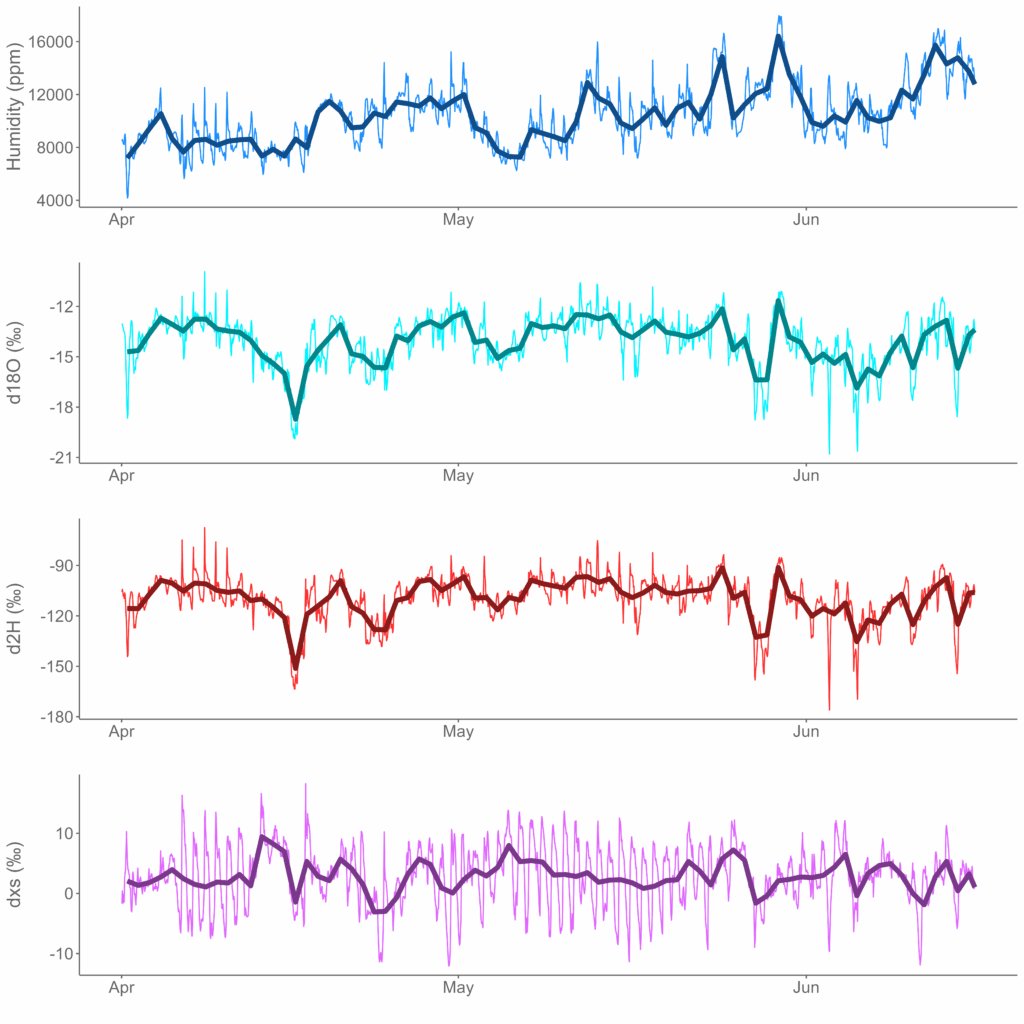
Our project ISO-TAISE provides the infrastructure to capture and study the isotopic ratios of vapor and rainfall of Irish AR events and other extreme storms for the first time. An isotopic analyzer installed at the Trinity College Botanical Gardens in south Dublin is continuously sampling the Irish air and capturing an isotopic ratio of its water vapor once every second. For the next three years, it will record these isotopic data alongside manual collection of rainwater, including during every storm event that impacts Ireland during this time. Our project team will then analyze the isotopic data from extreme storms and reconstruct where the vapor that fueled the storm came from and how the storm evolved as it charged toward Ireland.
Overall, our goal is to find common patterns in how our extreme storms and AR events form and gather moisture through this isotopic fingerprinting. Once we better understand what geography and other environmental factors tend to favor these storms, we can better assess potential risks of future events whose likelihood may shift as climate change and climate teleconnections alter the breeding grounds of Irish extreme storms.

This project is funded under the EPA Research Programme 2021-2030. The EPA Research Programme is a Government of Ireland initiative funded by the Department of the Environment, Climate and Communications. DISCLAIMER: Although every effort has been made to ensure the accuracy of the material contained in this website, complete accuracy cannot be guaranteed. Neither the Environmental Protection Agency nor the authors accept any responsibility whatsoever for loss or damage occasioned or claimed to have been occasioned, in part or in full, as a consequence of any person acting or refraining from acting, as a result of a matter contained in this website.